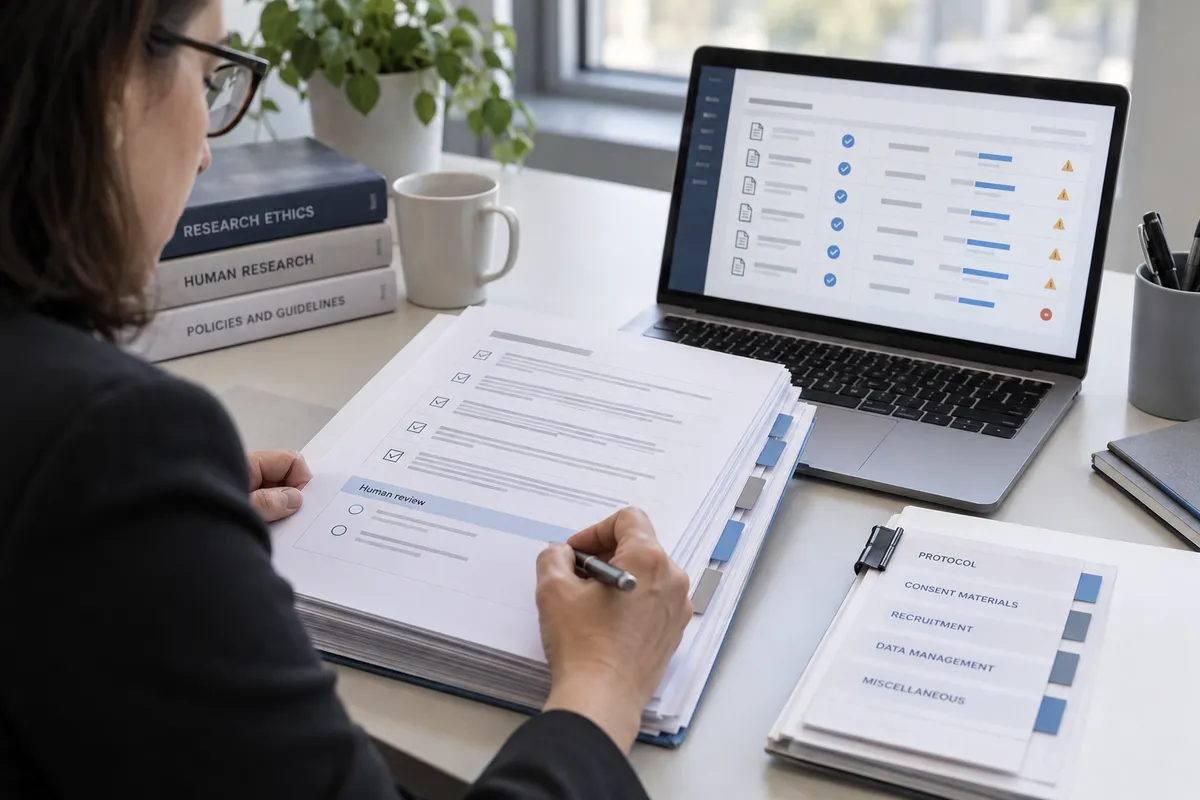
Before a researcher can interview patients, run a survey, or test a new treatment, an ethics committee has to sign off. A surprising amount of the wait isn't about weighty moral questions. It's about paperwork: is the consent form complete, does the application match the published standards, did someone miss a required section?
That's the part a new University of Bristol study says AI could handle. Per the report on Phys, large language models can check research ethics applications against published standards in minutes. The takeaway for you, whether you submit applications, sit on a committee, or just wonder where AI is actually useful: the smart use of AI here is as a checker, not a judge.
What the Bristol study found
The researchers tested large language models on checking ethics applications against published standards. According to the report, Claude outperformed both ChatGPT-4o and Microsoft Copilot on accuracy, speed, and error detection.
The core argument, as the coverage frames it, is that AI can streamline routine compliance checks while human judgment remains essential for the ethical decisions themselves. I can't tell you from the coverage how the tests were set up or by how much Claude won, so treat the ranking as a headline result rather than a final verdict.
Why paperwork is the right target
Research approvals are often slowed by administrative review. A reviewer has to read an application line by line and compare it against a standard. That's repetitive, structured, and document-based, which is exactly where software that reads text quickly tends to help.
Compare that with the question a committee really exists to answer: is this study fair to the people involved? That calls for context, values, and accountability. The study's framing suggests keeping those with people.
The description of the work puts it simply: AI could improve efficiency for professionals handling ethics reviews, freeing humans to focus on the ethical decision-making.
Assistant versus decision-maker
This distinction matters well beyond ethics boards. It applies to healthcare, regulation, and any field where a mistake affects real people.
AI as an assistant
The tool does a first pass. It flags missing items or mismatches with the standard. A person reviews the flags, checks the work, and decides what to do. If the tool is wrong, a human is positioned to catch it.
AI as a decision-maker
The tool's output is the outcome. Nobody is weighing the reasoning, and responsibility gets blurry. Nothing in the Bristol findings, as reported, supports handing over the final call.
Why the choice of model matters
It's tempting to assume all AI chatbots are interchangeable. This study suggests otherwise: the three tools tested differed on accuracy, speed, and how many errors they caught. For a compliance check, missing an error is the costly failure, so error detection is arguably the number that matters most.
If your institution is considering one of these tools, a practical approach follows from the findings:
- Test on your own documents. A result from one study doesn't guarantee the same performance on your forms and standards.
- Measure error detection, not just speed. A fast check that misses problems isn't saving anyone time.
- Keep a person accountable for sign-off. The AI flags; a human decides.
- Compare more than one tool. The Bristol results show performance gaps are real.
Those steps are my suggestions drawn from the study's logic, not instructions from the researchers.
What could change for researchers
If routine checks take minutes instead of waiting in a queue, the likely benefit is fewer delays in medical and academic projects. A researcher might fix a missing section before a committee ever sees the application. Reviewers, in turn, could spend their time on the hard cases rather than on spotting formatting gaps.
That's a reasonable expectation, though it's a projection, not a measured outcome from the study as reported.
The trust question
Institutions are under pressure to use AI responsibly without damaging trust or oversight. Ethics review is a place where trust is the whole point: participants and the public need confidence that someone careful looked at the research. Using AI openly for narrow, checkable tasks, with humans visibly in charge, is a more defensible position than using it for everything or refusing it altogether.
The takeaway
When you consider AI for any high-stakes process, start by asking which parts are checking and which are deciding. Give the checking to the machine, if it proves itself on your own documents, and keep the deciding for people.