Open shelves, racks, and other visible storage are popular in small homes, rentals, kitchens, and closets. They're also unforgiving. Per the Washington Post's piece on the topic, too many items, or mismatched pieces, can make a room look disorganized and messy.
The good news: the fix is a method, not a bigger budget. The four moves below, editing, grouping, coordinating color, and containing, are the ones that turn a pile into a display. You can try them on a single shelf in about half an hour.
Start by taking everything off
The fastest way to see why a shelf looks cluttered is to empty it. Put every item on a table or the floor, wipe the shelf, and look at the bare structure. Then decide what earns its way back.
This is the editing step, and it does most of the work. A shelf that holds fewer things reads as deliberate. One that's packed edge to edge reads as overflow, no matter how nice the individual objects are.
A simple editing test
As you return items, ask two questions:
- Do I use this regularly, or do I genuinely like looking at it?
- Does it relate to something else on this shelf?
If the answer to both is no, it belongs in a closed cabinet, a drawer, or a donation bag. Open storage should be reserved for things that are either useful or good-looking, ideally both.
Group like with like
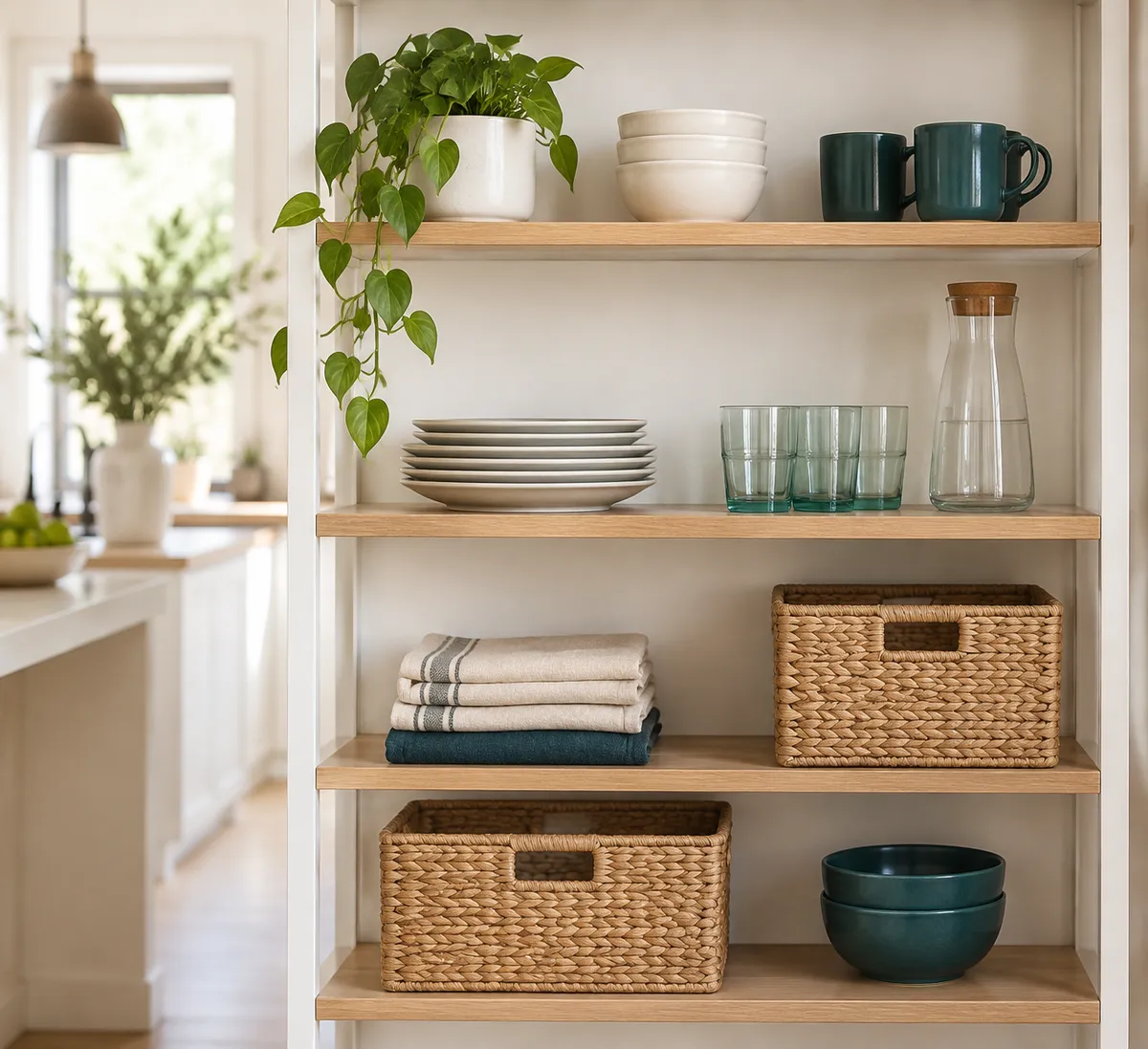
Scattered, unrelated objects are a major source of visual noise. Grouping is the cure. Put all the mugs together, all the cookbooks together, all the folded towels together. Your eye reads a cluster as one unit instead of five separate things competing for attention.
A few practical ways to group:
- By function: drinking glasses on one shelf, baking supplies on another.
- By category: books with books, baskets with baskets.
- By zone: in a closet, keep everyday items at eye level and occasional ones higher.
Grouping also helps you find things. When everything has a home, putting it back becomes automatic, which is what keeps the shelf tidy next week and not only today.
Narrow the color palette
Mismatched pieces are one of the specific problems called out in the Washington Post's framing, and color is the easiest way to solve it. You don't need everything to match. You need it to feel related.
Try this:
- Pick two or three colors that already dominate the shelf.
- Move items outside that range to another room, or swap them for neutral versions.
- Turn busy labels inward, or decant them (see below).
Brightly branded packaging is a common culprit. A shelf of cereal boxes, spice jars, and cleaning products in a dozen competing colors will look chaotic even if it's perfectly organized.
Use containers to hide the messy parts
Containers are the bridge between visible and tidy. Baskets, bins, boxes, and matching jars can corral small or awkward items so the shelf shows clean shapes instead of loose odds and ends.
- Use baskets for things that don't stack well, such as scarves, toys, or kitchen linens.
- Use matching jars or canisters for pantry staples so labels and colors don't clash.
- Use boxes with lids for papers, cables, and anything you'd rather not display.
Keep the containers consistent in material or color. Five different basket styles can recreate the very mismatch you were trying to remove.
Leave breathing room
Empty space is part of the design. Leave visible gaps on each shelf, so the items you chose have room to be seen. If you fill every inch, you've simply rebuilt the clutter in a neater arrangement.
A workable habit: when you finish styling, step back and remove one more thing. It's usually the right call.
Vary height and scale, within reason
A row of identical-height objects can look stiff, but random heights look messy. Aim for a deliberate mix: a few taller items, some medium, some low, arranged so the eye moves smoothly across the shelf. Placing heavier or larger pieces on lower shelves also tends to look more stable and balanced.
Adapt it to your space
Open storage shows up in several places, and the same principles apply with small tweaks.
Kitchens
Display only what you use daily, such as everyday dishes and a few nice glasses. Keep mismatched gadgets and promotional mugs behind closed doors.
Closets and clothing racks
Fold or hang by category and color. A rack of clothes in a gradient looks calm; the same clothes in random order look like a pile.
Rentals and small rooms
When you can't add built-in cabinets, open shelves and racks do the job. Lean on containers to keep things contained, and edit more strictly, since a small room shows clutter faster.
A quick before-and-after routine
Want to see the difference for yourself? Photograph your shelf as it is now. Then:
- Remove everything and wipe down.
- Sort into keep, relocate, and donate.
- Group what's left by function.
- Cut anything that clashes with your chosen colors.
- Contain small items in baskets or jars.
- Leave gaps, then take one more thing away.
Take a second photo. The comparison usually makes the lesson stick, and it gives you a reference to return to when the shelf starts drifting back toward chaos.
The one habit that matters
Before anything new goes on an open shelf, decide what comes off. Keep that one-in, one-out rule, and your open storage will stay looking intentional.