
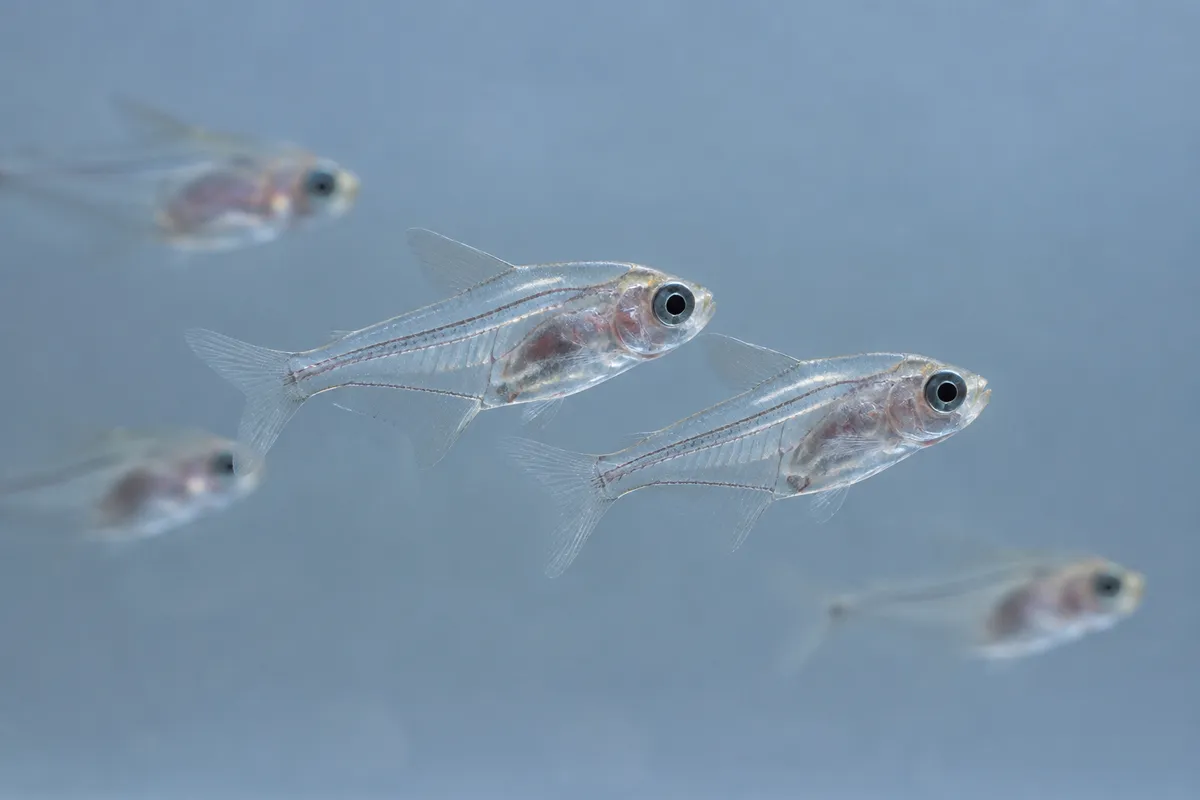
Picture a school of fish turning in perfect unison, hundreds of bodies flipping direction as if wired together. The natural assumption is that each fish is tracking the whole crowd and averaging everyone's movements. According to a study reported by Phys, that assumption is probably wrong. By the end of this article, you'll know the much simpler rule these fish appear to follow, and how scientists used virtual reality to test it.
The finding: one fish, one neighbor, one split second
Researchers at UC San Diego studied micro glassfish and found that their schools form through split-second "copying" of one nearby neighbor at a time. The fish are not averaging the movements of the entire group, per Phys's report on the work.
That is a big shift in how we picture collective behavior. Flocking birds, swarming insects and schooling fish have fascinated scientists for centuries. The new work suggests the grand coordination we see from the outside can come from a very small rule on the inside.
Why the "follow the whole crowd" idea is tempting
When you watch a school move as one, it looks like the fish must be processing everything at once. Crowd-wide averaging feels like the natural explanation for such smooth, shared motion.
The pairwise-copying model flips this. Each fish pays attention to a single neighbor, matches it quickly, and then the same thing happens across the group. No fish needs a view of the whole school. The pattern you see is what many tiny, local decisions look like when they add up.
How virtual reality put the idea to the test
A model is only useful if real animals behave the way it predicts. This is where virtual reality came in. The researchers tested real fish with virtual neighbors, and the fish responded in ways predicted by the pairwise-copying model, according to Phys.
This is a clever use of VR for animal research. A virtual neighbor can be controlled precisely, so scientists can see how a real fish reacts to a specific movement without the messy variables of a live crowd. If the fish respond to a computer-generated neighbor the way the model says they should, that is strong support for the model.
Why glassfish are such a good subject
Glassfish are transparent. That matters because it makes it possible to study how tiny brains generate complex group decisions in real time, per the report. A see-through fish offers a rare chance to link what an animal perceives to how its brain processes that information and, in turn, how the group moves.
That link between individual perception, brain processing and group movement is what makes the study notable. It isn't only describing what schools do; it points toward how they do it.
What this might say about following the crowd
The following is our own interpretation, not a claim from the study. The result nudges us to think about social influence more literally. We often say people "follow the crowd," but the fish suggest a crowd may not be a single thing anyone follows at all. It may be a web of one-to-one influences, each person or animal reacting to whoever is nearby.
The researchers' work is on fish, and nothing here shows humans behave the same way. But it is a useful mental model:
- Look local. If a group seems to move with a shared mind, ask who is actually influencing whom at close range.
- Expect simple rules. Complex group patterns don't require complex individual thinking.
- Small inputs add up. One quick copy, repeated across many individuals, can look like deliberate coordination.
Where to see this idea in everyday life
You can't run a VR experiment at home, but you can watch for the same kind of pattern. Next time you see a flock of birds wheel overhead or fish in an aquarium turn together, try tracking just one individual and the one beside it. Notice how quickly a change passes along. You are looking at the kind of local, rapid response the UC San Diego team describes, though whether a given flock or tank follows the same rule is a separate question the study doesn't answer.
The takeaway
When something looks like it takes a big, coordinated plan, look for the small rule underneath. For glassfish, it appears to be as simple as watching one neighbor and matching it, fast. Start by watching one pair, not the whole crowd.