Picture an Egyptian mummy and you probably see a royal figure, arms crossed, inside a gorgeously decorated sarcophagus. After reading this, you'll have a better picture: a crowded, carefully organized family-style tomb where burial customs changed over 300 years, and where someone placed a mummified dog on top of two people.
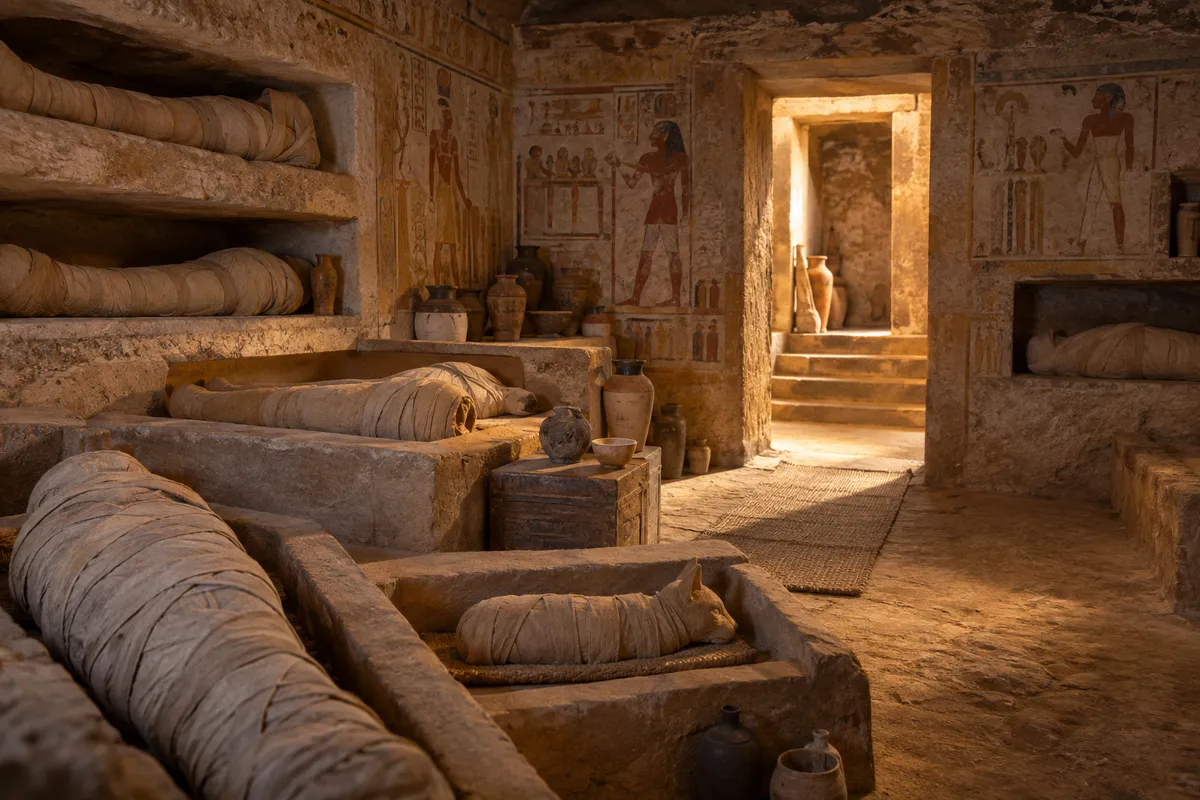
That tomb is TT 209, in the Theban Necropolis near Luxor. Per Popular Science, a team from Spain's University of La Laguna described its remains in a study published in the journal Frontiers in Environmental Archaeology. Chamber three holds at least 20 ancient Egyptians and one dog.
Why One Crowded Tomb Matters
Ancient Egypt lasted over 3,000 years, and the royal-in-a-sarcophagus image is only one burial tradition among many. Usually, tracing how funeral rites shifted means visiting multiple sites. Here, according to the report, a single chamber spans more than 300 years.
The Theban Necropolis is a complex of over 400 burial sites. TT 209 was first built during the 25th Dynasty (754–656 BCE), also known as the Nubian or Kushite Empire, and was reused for generations afterward.
How the Team Studied It
The researchers excavated the tomb, then photographed and sketched its occupants. They described each mummy's orientation and position within the structure. In total, they documented nine separate funerary deposits, including single and group burials, along with personal objects and religious items.
The timeline showed that space in the chamber became more valuable with each generation.
The Earliest Burials: Coffins and Costly Goods
The first people laid to rest here appear to have been wealthy. Egyptologist Miguel Ángel Molinero Polo, a study co-author, explained that they were interred in coffins, with funerary nets and amulets, alongside an assemblage of costly items.
Later Burials: Packed Vertically, Still Cared For
By the end of the 25th dynasty (listed in the report as 680–404 BCE, a span also called the Persian period), attendants had to adjust. Mummies went wherever space allowed, which sometimes meant different limb positions. Instead of the earlier individual interments, almost two-thirds of TT 209's deceased were arranged vertically.
That might look like decline. The researchers say it wasn't. Many later mummies still had arms folded over their chests in the Osirian position. Molinero Polo said the vertically stacked bodies had no coffins but were carefully mummified, and can be associated with upright jars pointing to a specific ritual not found in the tomb's earlier phases.
"Disordered" Tombs Deserve a Second Look
This finding pushes against earlier theories that some Egyptian burial sites grew more chaotic as they filled. Co-author Jared Carballo-Pérez said in a statement that the bodies show "neither chaotic accumulation nor a loss of the original ritual over time." Instead, he described "a spatial logic in which each new deposition was adapted to the presence of previous bodies—a kind of funerary memory in the processes of reuse."
He added that deposits previously considered "disordered" can be reinterpreted. The takeaway from the report is that care and respect remained a staple of funerary practice for centuries.
The Dog on Top
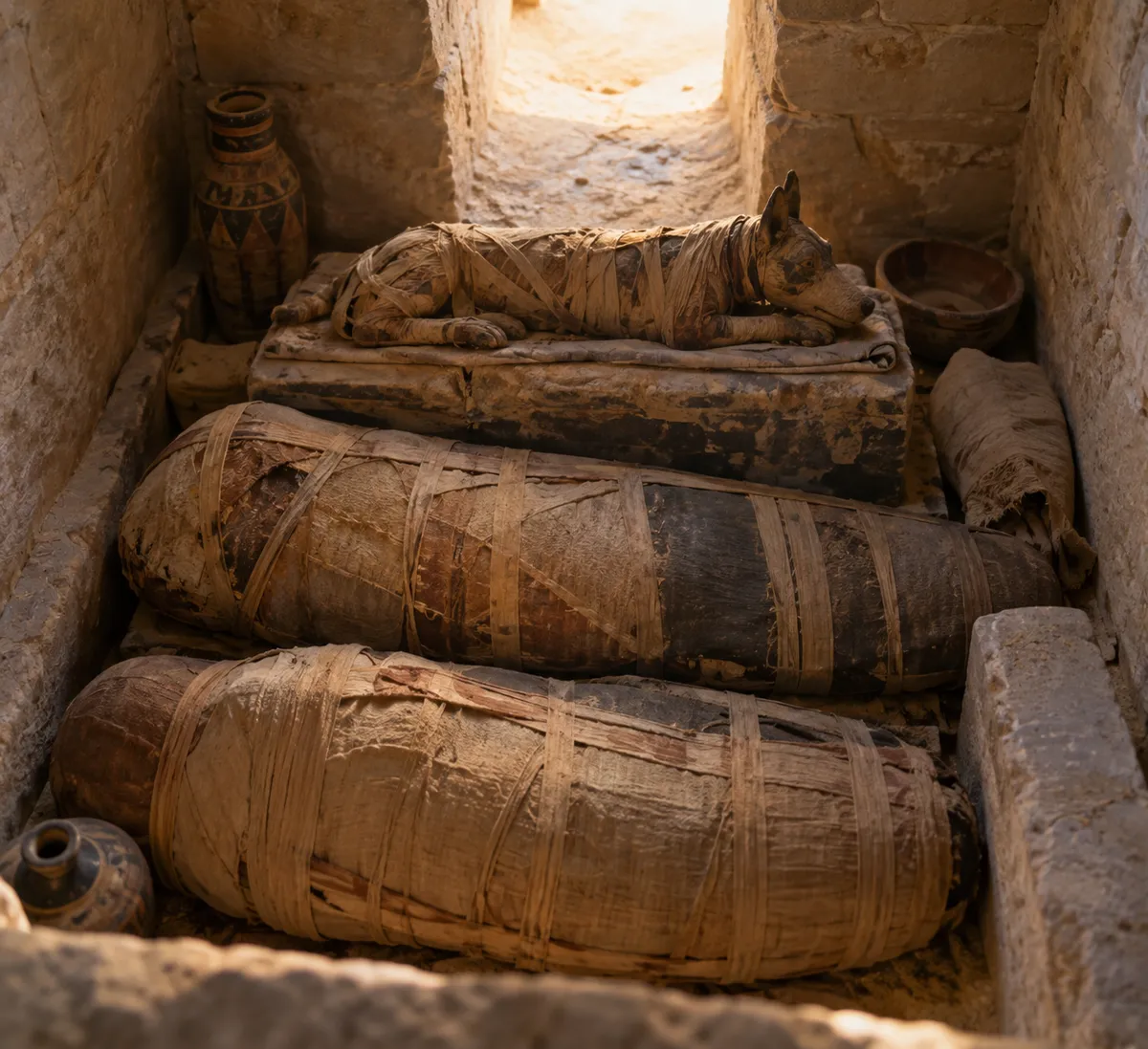
In one case, a mummified dog was placed directly over a man and a woman. The study's figure caption describes the canid lying over the lower limbs of two closely stacked individuals.
Carballo-Pérez told Popular Science's account of the study he finds it "quite beautiful," suggesting it "could indicate a close relationship between these human individuals and the animal." That's his interpretation, and the researchers don't claim certainty. Still, it's an easy idea to empathize with.
How to Read a Crowded Tomb
Next time you see a packed ancient burial site, try these questions, inspired by how this team approached TT 209:
- Look at orientation. Are bodies arranged in a consistent pattern, such as folded arms?
- Check for goods. Coffins, amulets, and costly items point to social standing; their absence doesn't mean carelessness.
- Follow the sequence. Did later burials work around earlier ones? That suggests planning rather than dumping.
- Notice the extras. Jars, objects, and animals can signal rituals that changed over time.
The next time a tomb looks messy, ask whether the people who filled it were working around the dead on purpose.